The Morning Star Is Now Available!

Friday, February 11, 2022

Regrets-I Have a Few


For of all sad words of tongue or pen, The saddest are these: ‘It might have been!”―John Greenleaf Whittier

Last month when we were featuring some of our exceptional schools, I started thinking about my school days, and for the most part, they were a positive experience. However, there is one thing I regret and that is not learning to play an instrument. As far as regrets go, I guess that’s pretty mild. I don’t have biggies like regretting robbing a bank, cheating on my husband, or posting an embarrassing video on the internet. I’m naturally cautious and have always looked at things I’ve considered doing through the lens of what will be the consequences of this or how will this turn out in the future? And will I be happy with what could possibly result from a decision or action?

No matter how thoughtful you are, you will still end up in life with some regret. Acquiring them is unavoidable because, often times, they spring from a decision. For instance, I was a good student in high school but for a variety of reasons including monetary and lack of direction, I didn’t go to college right out of high school, I went to Duff’s Business Institute instead and became an Executive Secretary. I always felt I should have gone to college, but it just wasn’t the right thing at that time.

Although I had some regrets about that, had I gone to college fresh out of high school, I wouldn’t have met my husband, and as a silver lining, while at Duff’s the exceptional grammar and organizational skills I developed there and while working, laid the foundation for my writing career. I did go back an earned my degree when I was 49 and that leads me to something else.

According to psychologists, some of the biggest regrets people have at the end of their lives are:

1.       Not spending enough time with loved ones.

2.       Not trusting their instincts

3.       Not taking care of their physical health

4.       Wasting their life by worrying too much

5.       Not taking risks.

Regrets can be paralyzing for some. I’m not a therapist, but here’s my take on regrets. They are useless. Like the past, they can’t be changed. They’re just baggage. If you can’t get over a regret, seek help. If you can correct a regret, like not learning an instrument or acquiring an education, do it. But most important of all, live your life from now on so as not to regret things later.

Wednesday, December 8, 2021

Are You a Reader?


As you many of you may know, in my spare time, I write novels. This is the time of year for craft shows and festivals, and for the past few years, I’ve been attending several of them to sell my books. Unlike the many handcrafted items showcased at them such as floral arrangements, jewelry, or knitted or crocheted items, books aren’t as eye-catching a ware to sell. To generate interest, I’ve found it best to engage customers as they stroll by my display of novels by asking them a simple question: Are you a reader?

 So many books, so little time!

I usually get one of three answers: An enthusiastic, “Yes, I love to read!” Or an exasperated “I like to read, but I don’t have the time.” This is the answer usually given by a mom pushing a stroller, which is understandable as little ones require a lot of attention. The third answer is one I have trouble fathoming and that is the short reply, “I hate to read.” Some are apologetic when they admit that, appearing to be ashamed about their distaste for reading, while still others are shockingly proud of it. I’ve even had a few people tell me that they haven’t read a book since they left high school decades ago. 


According to a 2021 Pew Research survey of U.S. adults, nearly a quarter of American say they haven’t read one book in the last year. I am not here to heap scorn on those who don’t read because I suspect somewhere during your formative years you may had difficulty reading or was forced to read books you didn’t like making reading a chore. I understand that; reading is an acquired skill and unless you have a learning disability, the more you do it, the easier it becomes. Also, I understand being forced to read boring books. I had to read Heart of Darkness in high school, and even though I loved reading, I found that book insufferably boring.


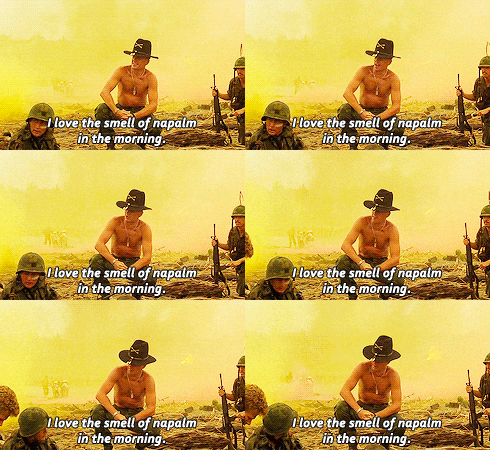
 Apocalypse Now based on the book Heart of Darkness. 

But reading for pleasure is vastly different from reading for a grade, and if you count yourself among the non-readers, I encourage you to try reading again. Here are a few benefits that reading provides to convince you. It stimulates your brain, and some studies even indicate that it may help to stave of dementia. It increases your knowledge. It keeps you from being bored. It stimulates the imagination. It allows you to travel to other times and places and enables you to experience things you could never outside of a book. Reading reduces stress as it can take your mind off problems. It is entertaining and is one of the most affordable forms of entertainment. For $25 or less, you can be entertained for hours. It can be free (if you go to your library). Reading is a great conversation starter. Readers love to talk about books. Reading binds people together. Readers love to connect. One of the most encouraging things I’ve learned while selling my books is that book clubs are still flourishing. After all these months of isolation joining or being in a book club is a great way to socialize. 


As we approach the holiday season, now is the ideal time to give reading a go again. I once saw that the best Christmas list is one that includes something you want, something you need, something to wear and something to read. Ask a bookworm for a recommendation for a good book they loved and then ask Santa to bring you it. Then for January, the time of the year when we make resolutions, commit to reading. You will be holed up for the winter, which makes it a great time to dive into a good book.

Reading is also a habit, albeit a pleasurable one. Start with reading a page a day. I guarantee you’ll be happy you did. 

This article originally appeared in the December issue of Northern Connection magazine.

Thursday, November 4, 2021

The Great Equalizer

 As a teen growing up in the 1970s, I went to a lot of rock concerts from Bruce Springsteen and Styx to Foreigner and Tom Petty to Kansas, Queen and many others. Back then there was little access to rock stars. There was no following them on Facebook, Twitter or Instagram. They made very few appearances on television outside of The Midnight Special or Don Kirschner’s Rock Concert. Most news about rock stars came through magazines like Creem, Circus, and Rolling Stone. Consequently, rock stars were treated as . . . well, as rock stars. They were lionized, placed on pedestals, and lived larger than life in the minds of most fans.

For instance, graffiti in London in the mid-1960s proclaimed about Eric Clapton that “Clapton is God.” John Lennon of The Beatles stirred controversy when he cheekily stated in March 1966 interview that The Beatles were “More popular than Jesus.” Led Zeppelin’s lead singer Robert Plant was proclaimed “The Golden God.”


Fast forward four decades, and many of these rock stars are still touring. Several years ago, Jergel’s Rhythm Grille in Warrendale, brought Lou Gramm, Foreigner’s lead singer, to town, and we happened to get tickets. Before the concert began, I went to the Ladies Room, and as I left, I had to pass through a vestibule and glass doors to get back into the main room. And guess who held the door for me? Lou Gramm. When I got back to our seats, I told my husband about it and laughed that had that happened 40 years ago, I’d have been delirious, but now he was just an average-looking middle-aged man, and I just said thanks.

We saw The Who about five years ago, and although Pete Townsend didn’t jump as high while strumming his guitar and Roger Daltrey laughed about how his voice would probably crack when he screamed on We Don’t Get Fooled Again, the concert was great. 

In 2019, Phil Collins came to town. He can no longer play the drums for health reasons, and on the big screen with his glasses and bald head, he looked like my dad singing In the Air Tonight. But Phil still had it and made the concert fun and amazing.

Rod Stewart came to town a few years ago too. Everyone in the crowd had a good laugh, when on the big screen, the cover of a Rolling Stone issue with a picture of him in 1978 appeared. It was published when his song Da Ya Think I’m Sexy came out. He quoted the article back then where he said he didn’t want to be in his 60s and still singing that song. It would be ridiculous. He laughed, and said, “Guess what, I’m 72 and I’m singing it tonight.”

This past October 4, I saw The Rolling Stones for the first time at Heinz Field, and although Mick Jagger is nearing 80, he still strutted, posed and rocked the stadium. At one time, I looked at my husband and said, "Forty-five years ago, did you ever think you'd be in your sixties and watching Mick Jagger still performing?" 


 The view from the cheap seats.

But with all these concerts there was a difference from the ones I attended when I was in my youth. From Phil Collins to Mick Jagger—all of them seemed to be more humble, relaxed and happier. In fact, Mick quipped, that sadly, he hadn’t had much time to spend in Pittsburgh; he didn’t get a chance to go “to the Warhol and gaze at myself.” It’s not often that an entertainer who comes to town has a portrait hanging in a museum. But rather than being haughty about it, he seemed to be amused by it all. 

Time catches up with everyone.  These rock stars are no longer gods but mortals just like the rest of us. Aging is the great equalizer. And I find myself liking and appreciating these performers even more now that we have become acquainted with their human sides. 

This article originally appeared in the November issue of Northern Connection magazine.