The Morning Star Is Now Available!

Monday, February 6, 2023

What Then?

When my twins were small, I used to belong to the Moms of Twins & Triplets Club, and at one meeting we had a child psychologist speak who gave us some good tips on how to help children behave. One particular piece of advice he imparted was to employ two little words: “if” and “then.” If you wanted to make your child comply or if they were pestering you, parents were instructed to say something like, “If you put your toys away, then we can go to the park.” Or “If you quit whining, then I will listen to you.”

Those little words worked like magic and staved off a lot of conflict. They even worked personally. Many times over the years, I’ve told myself things like, “If you go to the gym, then you can come home and read.”


While those words are a pair of gems, I think there are several other phrases that would be helpful to use and the first is “What then?” It seems that a week doesn’t go by without a video going viral of someone doing something ridiculously stupid or of people doing something foolish or risky. Take for instance selfies. Taking pictures of yourself with your cell phone and placing yourself in jeopardy is widespread. So much so that Wikipedia has a “List of Selfie-Related Injuries or Deaths” entry, which compiles the enormous number of people who have been harmed or died while taking their picture.

In 2014, the U.S. Department of Transportation estimated that 33,000 people alone were injured while taking a photo of themselves while driving. That doesn’t take into account those who fell off cliffs, were swept out to sea, or fell off moving trains while taking their picture. 
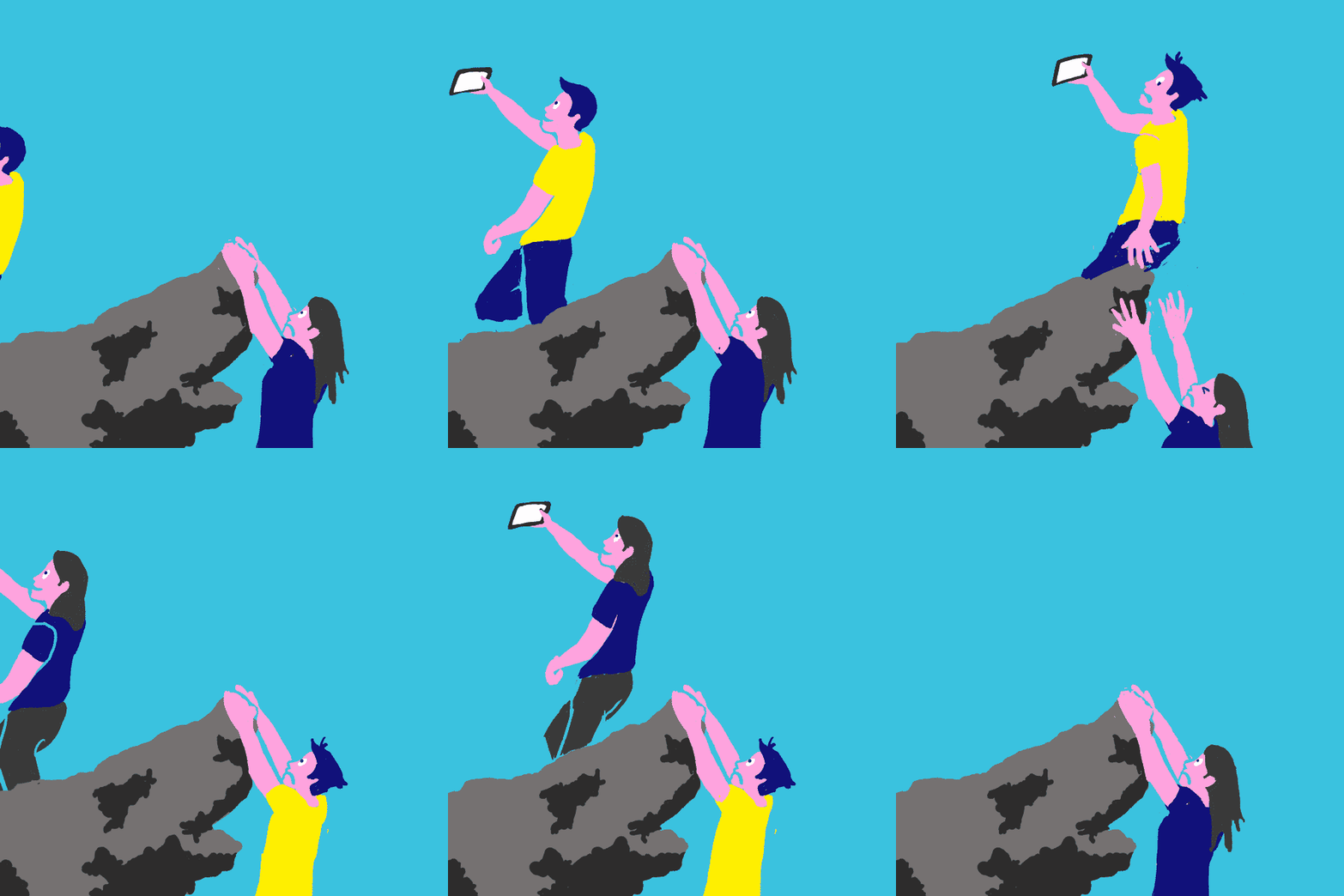


But it’s not only selfies. It seems these days very few people ask themselves, “What then?” before doing something. Life comes with risk, but when it comes to risky behavior or thinking about the results of those actions, it seems that some people ignore the possible consequences. We even see it in our elected leaders. Do they ever consider that when they release convicted inmates early on to the street, or choose to not prosecute them, that it’s not surprising that crime skyrockets.

When my youngest was in grade school, they taught him this little jingle: Pause, Reflect, Show Some Respect. Our society values and promotes action. We all know the phrases, "Just do it" or "It’s go time." Looking back on some of the mistakes I’ve made, many of them could have been avoided if I’d paused. 

Maybe we’d be better off if we encouraged people to pause, think about what we are about to do, and follow that to its likely conclusion by asking "What then?" In so doing, we’d create less trouble for ourselves and society.  


This article originally appeared in the February 2023 Issue of Northern Connection Magazine.

Wednesday, December 7, 2022

Eating the Elephant


Last month my husband and I went on a trip to the Holy Land with our parish, touring Israel and Jordan. The trip was amazing. We visited sites we’ve read about in the Bible and or have seen in movies, like Petra, the ancient city carved into rock facades, which was featured in the film Indiana Jones and the Last Crusade.


Among the places we visited were Bethlehem, the birthplace of Jesus and the site of the first Christmas. We also visited Nazareth, sailed on the Sea of Galilee and floated in the Dead Sea. We rode camels in Jericho, walked the Via Dolorosa, the “Way of Sorrows” in Jerusalem to Jesus’s Crucifixion site and entered the Holy Sepulcher, the empty tomb of Jesus.

In Jordan, we visited Mt. Nebo, not the one with Sam’s Club and Target, and the Roman ruins in Jerash. We saw Bedouins herding sheep in the desert, visited Qumran, where the Dead Sea Scrolls were found, and placed prayers in the cracks of the Western Wall. It truly was the trip of a lifetime, and I encourage anyone who gets the chance to visit the Holy Land to do so.


 Sunrise over the Sea of Galilee, Tiberias, Israel


But then it was time to return home.

We left Jordan and did the complicated swap of having our bus driver and Jordanian guide transport us to the border, deposit us there to go through immigration, re-enter Israel, where an Israeli guide and bus driver picked us up and transported back to Jerusalem. We were having dinner in a hotel before our guide was to transport us to the airport for our flight from Tel Aviv to Newark and then on to Pittsburgh, when I thought to check on our flight status. When I saw a red warning that said “Canceled,” my heart sank. I asked if anyone else had checked the status, which prompted everyone to pull out their cell phones. Not only had our flight been canceled, but we had also been rescheduled on a later flight leaving Tel Aviv but terminating in San Francisco, making it a 15-hour flight. Then we had a seven-hour layover in San Francisco before departing on a connecting flight to Denver, and then flying back to Pittsburgh.

My husband and I had purchased preferred seats so that we could sit together, but the new flight had us both in middle seats-the worst possible places. A sense of desperation descended. I don’t sleep on planes. I didn’t think I could handle such an ordeal. We’d already been up 19 hours when we took off; all told, by the time we arrived home, I had been up for nearly 50 hours.

Many of you face or have faced far worse circumstances than travel troubles. I have a neighbor who had a health issue that left him in isolation for nearly a year until he received a bone marrow transplant. On the last leg of the trip, I sat next to an 81-year-old woman from West Virginia, who was flying back from visiting her grandchildren in Denver. She told me that when she was 27, her husband, who was a coal miner, had his skull crushed in a mining accident leaving her a widow with a two-year-old and new baby. She said she didn’t know how she made it through.

But I know how she did it, and anyone else facing dire, seemingly insurmountable circumstances, knows the secret. It’s the eating-the-elephant mindset. It was Desmond Tutu who said that “there is only one way to eat an elephant: a bite at a time.”


When I boarded that plane to come home, I tried to take it one hour at a time, one leg at a time, and find something good within each hour. I watched several movies and chatted a bit with my Israeli seatmate. In San Francisco, I had a delicious BLT sandwich, after no bacon for two weeks. And the lady from West Virginia was sweet and talking to her helped to pass the time. I never thought I’d be able to cope with being up 50 hours straight and being confined in a middle seat for 15 hours, and yet I did.

For any of you facing a challenge now or in the coming new year, remember to take it one small step at a time, find the good even in undesirable circumstances, and realize that you have more strength than you may realize. And before you know it, that elephant will be gone.

This originally appeared in the December Issue of Northern Connection Magazine.

Monday, November 14, 2022

Prisoners of Our Own Devices

We write our articles somewhat in advance because of printing deadlines; therefore, I’m writing this only two weeks after the autumnal equinox. I love summer so much, and as we bid this one farewell, I was thinking about what some of the best moments of this one were for me, and although a trip to the beach came to mind immediately, one small thing kept coming back to me.

Sometimes on Friday afternoons, I go to Mass, and one Friday at the beginning of August, I ran into a friend there, Patti. We went to high school together. Although she’s a friend, she’s not one I talk to every week. Nevertheless, she invited me back to her house that afternoon at 4 o’clock, explaining that she often has a few people over for an hour or two on Friday afternoons before dinner just to relax and celebrate the arrival of the weekend. As it happened, I was able to go, and I sat on Patti’s patio with her, and two other high school chums, Donna and Carol. We had simple snacks and iced tea, and we just talked for more than two hours until it was time to go home for dinner. There were no selfies, no music, no one pulled out a phone; we just sat in the summer breeze and laughed, reminisced, and talked about what was going on in our lives.

I don’t know if it’s because we’ve been so starved for human contact because of the lockdowns that it made just spending time together that much more special, but that Friday afternoon was one of the best times of my summer.

That evening, my husband and I went out to dinner, and I noticed something that I hope is not a trend. There were two different families at the restaurant and each of them had a small child with them, but what I noticed was that each of those children, instead of sitting and talking to their family gathered around the table, they had headphones on and were absorbed into an iPad screen. I know some children have sensory issues and as someone who had twins, I know it can be rough dining out with children, but how do children learn good behavior if they can’t ever be bored? How do they learn to relate to others if their eyes are glued to a screen?

I’m not the only one who has noticed that kids are missing out on the here and now. A Twitter firestorm erupted right after that trip to the restaurant when a woman posted this Tweet: “At Disneyland with the family and probably 50% of toddlers are strapped in their strollers on iPads or phones. At Disneyland. We are so screwed.”

There’s a funny online meme of a group of people seated around a table, and they are all ignoring each other and focused on their cell phones. It has a caption that hearkens back to the lyrics from The Eagles song Hotel California, and it says, “The Eagles were right, we are all just prisoners here of our own device.”

We are coming up on Thanksgiving, and I urge you to rediscover the beauty of connecting with others. Don’t become a prisoner of your screen. Sure, I’m going to take a few photos when everyone gathers to commemorate the occasion, but then I’m going to set aside my phone.

That feeling of peacefulness and connectedness I experienced this summer on Patti’s patio doesn’t have to be a rare event. It can happen anytime you are gathered. After long periods of isolation in lockdown it’s time to unplug and reconnect with others. Thanksgiving is meaningless if we don’t acknowledge and appreciate those seated around our table. Happy Thanksgiving!